
Virtuous Leadership: A Different Way to Lead
Severn Leadership Group develops and supports leaders and teams to be agents of transformation and exceptional outcomes. We call this approach Virtuous Leadership, and it rests on four convictions and five timeless virtues that shape everything we build.
What We Believe About Leadership
Every SLG program, from a single workshop to a five-month fellowship, stands on the same four convictions.
- Leadership and followership are defined by character and are relational in nature, not positional.
- Character is shaped by a timeless and transcendent set of core virtues, not by trends or personality.
- Service to others is not a style of leadership. It is a learned behavior, built through practice and accountability.
- Leadership and followership together create the effective teams that carry an organization’s mission forward.
The Virtue Proposition Framework
Five Timeless Virtues, Activated by Courage
LITER stands for Love, Integrity, Truth, Excellence, and Relationships, the five virtues that anchor every SLG program. Courage is the sixth, activating virtue: the one that turns principle into practice when it would be easier to stay quiet.
Love
Not a feeling, but actions of service and generosity to another, even when it requires one to be self-sacrificing.
Integrity
Alignment between family, personal, and professional lives, and consistently doing the right thing even when no one is watching.
Truth
Seeking and evaluating facts to distinguish and stand up for what is fundamentally right.
Excellence
A continuous pursuit of learning and improving, while growing in the virtues of Love, Integrity, Truth, and Relationships.
Relationships
Cultivating positive connections among individuals, groups, and communities to benefit everyone involved.
Courage
The activating virtue. It is what allows a leader to act on Love, Integrity, Truth, Excellence, and Relationships instead of simply admiring them.
How Character Becomes Culture
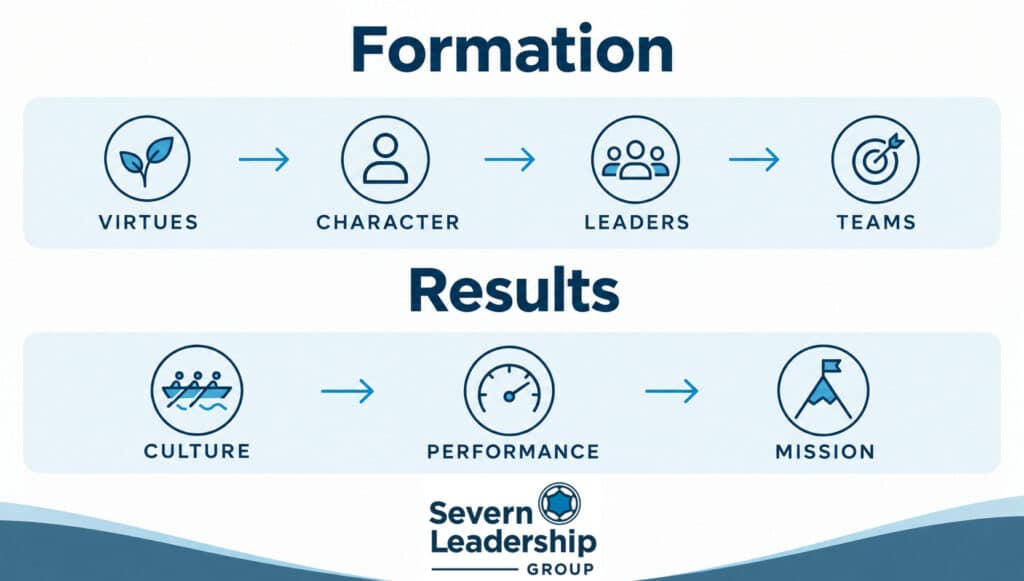
Virtue shapes character. Character shapes leadership. Leadership shapes teams. Teams shape culture. Culture drives performance. Performance advances the mission.
That progression, which we call the Virtue Proposition Framework, is the intellectual backbone of everything SLG teaches.
In our model, the leader is the integrator: the person who aligns people, purpose, and performance. The aspirational outcome is what we call an E* Team, a team committed to sustained, virtue-based excellence rather than a single good quarter.
This is the idea explored at length in Sig Berg’s “Virtuous Leadership: A Virtue-Based Framework for Sustained Excellence.” It is the reason SLG’s approach is genuinely different. Once you spend time with it, it is clear this is not another leadership framework with new vocabulary for old ideas.


The Team-First Principle
Command-and-control leadership optimizes for the leader. Quick-fix coaching optimizes for a single behavior or task. Competency models optimize for a checklist. Virtuous Leadership optimizes for the team, because a leader’s character only matters in what it makes possible for the people around them.
This is where SLG differs most from broader leadership institutes and traditional coaching: we do not treat the leader as the finished product. We treat the leader as the starting point for a healthier, higher-performing team.
Cohort, Mentor, Framework, Network
A cohort of peers
who ask harder questions than a solo course ever could, and who hold each other accountable long after the program ends.
A Certified Mentor
matched to each participant, providing one-on-one accountability grounded in the Virtue Proposition Framework and real experience, not a script.
The LITER framework
is a shared language for character and performance, so a team can name what is happening instead of just feeling it.
A constantly growing, lifelong network
that now includes 475 alumni and 120+ Certified Mentors, and stays with participants long after graduation.